- EdResearchForAction
- EdWorkingPapers
- EdInstruments



Tag: Teacher hiring and retention
-
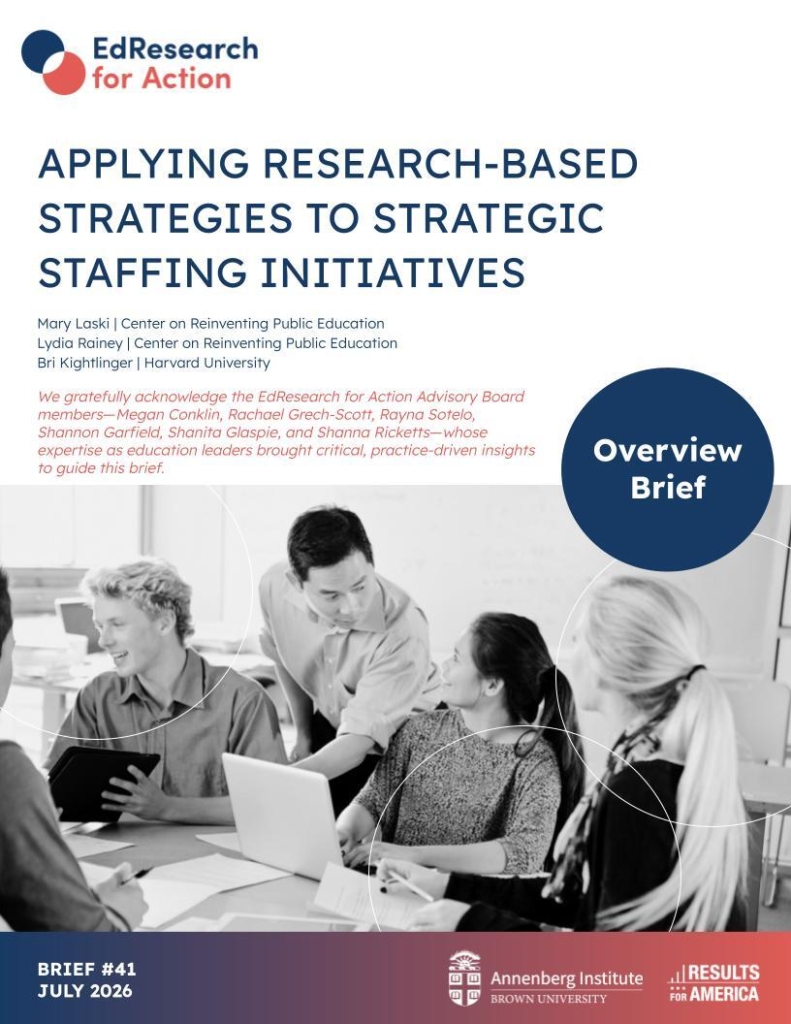
Applying Research-Based Strategies to Strategic Staffing Initiatives
This brief synthesizes research on strategic staffing, a framework for redesigning teaching roles, time, and compensation to better align educator expertise with student needs and ultimately improve teacher retention, instructional quality, and student outcomes. It examines why the traditional one-teacher-one-classroom model contributes to declining interest in teaching and high attrition, pointing to four compounding factors: unsustainable workload, insufficient autonomy and professional respect, limited career advancement, and pay disconnected from expertise and leadership. Drawing on decades of research, the brief reviews the evidence for the three core components of strategic staffing: collaborative teaching, which distributes instructional responsibility across teams; differentiated roles and career pathways, which create advancement opportunities such as teacher leadership, mentorship, and subject-area specialization without requiring teachers to leave the classroom; and differentiated compensation, which rewards leadership, specialization, and hard-to-staff roles with meaningful pay differentials. While each individual component is associated with improved teacher or student outcomes when well implemented, the evidence on comprehensive name-brand models that combine them, such as Opportunity Culture, Next Education Workforce, and the Teacher Advancement Program, remains preliminary. The brief closes with five implementation principles drawn from systems that have sustained these initiatives: communicating and building buy-in, co-designing with teachers, building capacity through professional learning, aligning policy and systems across school, district, and state levels, and working collaboratively with unions.